Car Diagnostics &
Electrical Services
San Marcos, TX · Serving Hays County & Central Texas
Full 61-point Digital Vehicle Inspection. All-module scan. OE-level software. Plain-language results before any repair begins.

Every Repair Backed by Our 24-Month / 24,000-Mile Warranty
We stand behind every diagnostic and electrical repair we perform. If something isn't right, bring it back — we'll make it right. No runaround, no excuses.
Common reasons to bring your vehicle in
Our approach
A Diagnostic Is a Process — Not Just a Code Pull
Many customers assume a diagnostic is just plugging in a scanner and getting an instant answer. In reality, a proper auto diagnostic combines technology, technician experience, and investigative work. We start by listening to you, test drive the vehicle when possible, scan every available module — not just the engine computer — and cross-reference findings with OEM data before we ever write an estimate.
A repair based on a confirmed diagnosis is far more likely to fix the actual problem the first time. It also protects you from paying for parts that were never the issue — which is one of the top reasons drivers distrust repair shops in the first place.
Schedule a DiagnosticWhat's included in every diagnostic visit:
- Detailed conversation about your concernsymptoms, history, patterns
- Test drive (1–2 miles)when vehicle is safe to drive
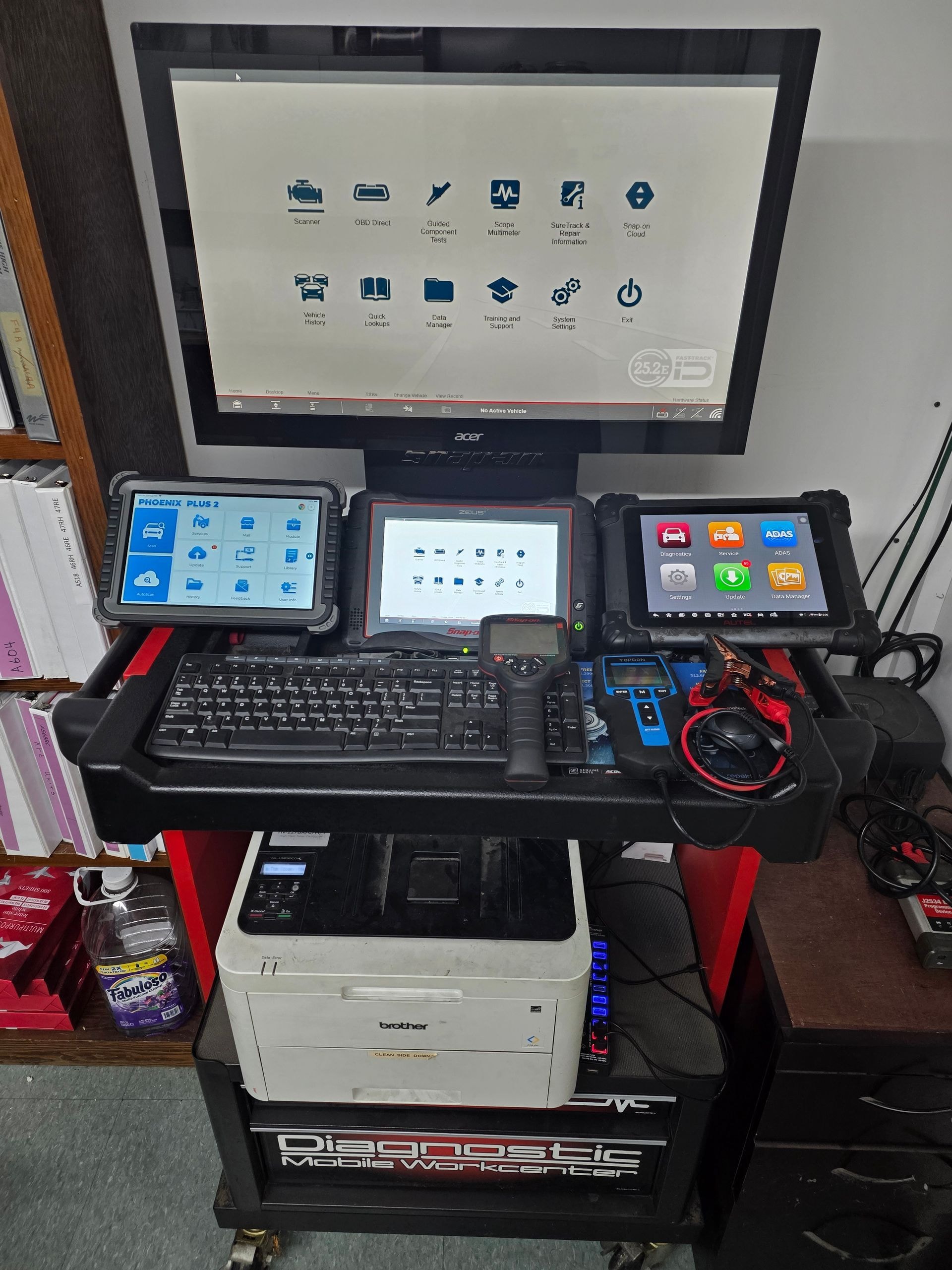
- Full all-module computer scanSnap-on, Topdon, Autel, OE software
- OEM data cross-referenceMitchell1, ALLDATA, Motor, ATRA
- 61-point Digital Vehicle Inspectionphotos, video, parts diagrams
- Plain-language explanation of findingsbefore any repair is authorized
Riley Auto Care & Transmissions — car diagnostics & electrical services serving San Marcos, Kyle, Buda, and New Braunfels.
Book a DiagnosticWhat we do
Car Diagnostics & Electrical Services
All makes and models — domestic trucks, import sedans, SUVs, and everything in between.
Full Computer Diagnostic Scan
Every available module scanned — not just the engine computer. Snap-on, Topdon, Autel, and OE software platforms.
61-Point Digital Vehicle Inspection
Documented with photos, video, and notes. A clear visual record of your vehicle's condition, not just a verbal explanation.
Electrical System Diagnosis
Flickering lights, power accessories, intermittent gauge behavior, wiring faults, and module communication issues.
Check Engine Light Diagnosis
Full code retrieval and root-cause testing — not just a code pull. We confirm the actual failure before recommending a repair.
ABS, Airbag & Traction Control
Safety system fault diagnosis using professional scan tools and live data monitoring.
Sensor & Module Testing
O2 sensors, MAF, MAP, crankshaft position, camshaft position, and other engine management sensors.
Wiring & Connector Inspection
Corrosion, abrasion, broken connectors, and shorts — traced using OEM wiring diagrams.
Transmission & A/C Diagnostics
Dedicated diagnostic paths for shifting concerns, slipping, and climate control faults. See our transmission and A/C pages for full detail.
Car diagnostics in Hays County — Riley Auto Care & Transmissions, 1334 TX-123, San Marcos, TX.
Book a DiagnosticUnderstanding vehicle diagnostics
Car & Vehicle Diagnostics: Why It Matters and What It Actually Involves
Why Diagnostics Get Skipped — And Why That's a Problem
Diagnostic time is, without question, one of the hardest services for customers to accept paying for. Unlike an oil change or a brake job, you can't see the "part" you're paying for. You're paying for a technician's time, knowledge, and use of specialized equipment to correctly identify what's actually wrong with your vehicle before any repair work begins. Because of that, a lot of shops lose business simply because customers would rather skip the diagnostic step and jump straight to "just replace the part I think is bad."
That instinct is understandable, but it often backfires. According to a AAA survey on consumer trust in the auto repair industry, roughly two-thirds of U.S. drivers say they generally don't trust auto repair shops, and when asked why, the top reason cited — by 76 percent of respondents — was being recommended unnecessary services. Ironically, proper diagnostic work is one of the best tools a shop has to protect a customer from exactly that outcome. A technician who takes the time to correctly diagnose a concern is far less likely to recommend a part that isn't actually the problem, because they've confirmed the failure before ever writing an estimate.
Skipping diagnostics doesn't just risk unnecessary spending — it also increases the odds of a breakdown. AAA's own roadside assistance data shows that roughly one-third of U.S. drivers admit to skipping or delaying recommended service or repairs, a habit that significantly raises the likelihood of an unexpected mechanical failure. And when an unexpected repair does happen, it's rarely cheap: the average unplanned repair bill runs between $500 and $600, and roughly one in four Americans say they couldn't afford a $2,000 car repair bill if it came up suddenly. Proper diagnostics, performed early and thoroughly, is one of the most effective tools for keeping small issues from becoming big, expensive ones.
Our Diagnostic Process
Every vehicle that comes in for a vehicle diagnostics concern goes through the same structured process, regardless of the make, model, or how minor the symptom might seem. Here's what that looks like from start to finish:
- 1
We start by listening. Before a single tool comes out, we sit down and talk with you about what you're experiencing. When did it start? Does it happen under certain conditions — cold starts, highway speeds, turning, braking, acceleration? Is it constant or intermittent? Has any other work been done recently? This conversation matters more than people realize. A vehicle's computer can tell us a lot, but it can't tell us that the noise only happens on left turns, or that the warning light came on right after a battery replacement.
- 2
We gather the details. We record the vehicle's mileage, service history if available, any recent repairs, and any patterns you've noticed. If you've had work done elsewhere recently, that's important context — sometimes a new symptom is directly related to a previous repair.
- 3
We test drive the vehicle whenever possible. For most concerns, we'll take the vehicle on a short test drive — typically one to two miles — to try to experience the symptom firsthand, monitor how the vehicle behaves under real driving conditions, and narrow down when and where the issue occurs.
- 4
We scan every vehicle for trouble codes. Every vehicle gets a full computer scan using professional-grade scan tools — Snap-on, Topdon, and Autel platforms, along with manufacturer-specific OE software when needed. We check every module the vehicle has for stored and pending codes, which helps us see the full picture rather than just the one light that happened to turn on.
- 5
We research the vehicle using OEM and industry-leading repair data. Once we know what codes or symptoms we're dealing with, we cross-reference that information using Mitchell1, ALLDATA, and Motor, along with the ATRA Tech Center for transmission-specific concerns. These platforms give us access to manufacturer wiring diagrams, technical service bulletins, known-issue databases, and factory diagnostic procedures — the same information dealerships use.
- 6
We perform a full 61-point Digital Vehicle Inspection (DVI). Alongside the diagnostic scan, every vehicle receives a 61-point inspection documented digitally with photos, video, and detailed notes, and parts diagrams when helpful. This isn't just about the original concern — it's a full look at the condition of the vehicle so you have a clear, visual record of what we found.
- 7
We explain what we found — in plain language. Once the diagnostic and inspection are complete, we walk you through the results in terms that make sense, even if you don't know anything about cars. We'll explain what the code or symptom means, what we found during testing, what we recommend, and why — before any repair work begins.
Why Modern Vehicles Need Real Diagnostics — Not Guesswork
Most modern vehicles have somewhere between 20 and 70+ individual electronic control modules, all communicating with each other over multiple internal networks. When something goes wrong, the "check engine light" or a warning message doesn't necessarily mean the problem is with the engine at all — it might be a communication issue between modules, a wiring problem, a sensor feeding bad information to multiple systems at once, or a fault that only shows up under specific conditions.
Some of the modules and networks commonly found on today's vehicles:
- Powertrain Control Module (PCM) — manages engine and often transmission operation
- Transmission Control Module (TCM) — manages shifting and transmission behavior, sometimes integrated with the PCM
- Body Control Module (BCM) — manages lighting, power accessories, locks, and other body electronics
- Anti-lock Braking System (ABS) / Electronic Stability Control module — manages braking behavior and traction control
- Supplemental Restraint System (SRS) module — manages airbags and seatbelt pretensioners
- HVAC control module — manages climate control functions
- Instrument cluster module — manages dashboard gauges and warning lights
- Various communication networks (such as CAN bus) — allow all of these modules to "talk" to one another
Because these systems are so interconnected, a single symptom can have several possible causes across multiple systems. A code reader that only checks the engine computer can easily miss a fault that's actually rooted in a completely different module — which is part of why cheap, surface-level scans (including many free code-pulls) often don't tell the whole story.
Most Common Codes and Diagnostic Concerns
While every vehicle is different, certain diagnostic trouble codes (DTCs) show up far more often than others across nearly all makes and models. According to Carfax, some of the most frequently seen check engine light codes include:
- P0300–P0308 (Misfire codes) — indicate that one or more cylinders aren't firing correctly; can be caused by ignition components, fuel delivery issues, or mechanical engine problems
- P0420 (Catalyst efficiency) — indicates the catalytic converter isn't performing as efficiently as expected, though this code is frequently triggered by an unrelated sensor issue or exhaust leak rather than a failed converter itself
- O2 sensor codes such as P0130, P0133, P0134, P0141, P0161, P0171, and P0172 — relate to oxygen sensors that monitor exhaust gases and help the engine computer fine-tune the air-fuel mixture
- P0442 / P0456 (EVAP system leak) — usually related to the evaporative emissions system, and sometimes as simple as a loose or worn gas cap, though not always
- P0128 (Coolant thermostat) — indicates the engine isn't reaching operating temperature within the expected time, often due to a thermostat stuck open
It's worth noting that a code name gives you a starting point, not a diagnosis. A P0420 code, for example, doesn't automatically mean the catalytic converter needs to be replaced — in many cases, the actual problem is upstream of it. This is exactly the kind of situation where skipping proper diagnostic work and replacing the "obvious" part often leads to a repeat visit, additional expense, and a customer who's understandably frustrated that the original problem still isn't fixed.
Why "Just Replace the Part" Doesn't Always Work
Diagnostic trouble codes describe a symptom, not always a cause. A code for a lean fuel condition, for example, could point to a faulty sensor, but it could just as easily be caused by a vacuum leak, a failing fuel pump, a wiring issue, or an intake gasket problem. Replacing the sensor in that case wouldn't fix anything — the new sensor would simply report the same lean condition all over again, because the actual root cause was never addressed.
This "parts-cannon" approach — replacing components one at a time hoping something sticks — tends to cost customers more in the long run, not less. Each unnecessary part comes with both a parts cost and a labor cost, and if the real issue still isn't found, the vehicle comes back with the same complaint, sometimes worse than before because time has passed and the underlying problem was never resolved. A proper diagnostic process is specifically designed to prevent this cycle by confirming the actual failure before any parts are ordered or installed.
Aftermarket Parts and Compounding Issues
Aftermarket replacement parts are an important and legitimate part of the auto repair industry — they expand options and can reduce repair costs. But part quality in the aftermarket world varies significantly between manufacturers, and lower-quality components can sometimes create diagnostic and reliability issues of their own. A sensor manufactured slightly outside of factory tolerances, for example, might function well enough to pass basic function checks but still feed inaccurate data to the vehicle's computer, triggering codes or drivability symptoms that didn't exist before the part was installed.
This becomes especially relevant with electrical and sensor-related components, since these parts often need to communicate precisely with a vehicle's control modules. A slightly out-of-spec part in this category doesn't always show up as an obvious failure — it can instead create an intermittent code, a false trouble code, or a symptom that mimics a completely different problem. This is part of why, when diagnosing a vehicle that's already had aftermarket parts installed, we always factor that history into our testing.
Serving San Marcos, Kyle, Buda, New Braunfels & Wimberley — Riley Auto Care & Transmissions on TX-123.
Book a DiagnosticHow Diagnostics Save You Money in the Long Run
It's easy to see diagnostic time as an extra cost tacked onto a repair. In practice, it's usually the opposite — it's what prevents unnecessary cost. Here's how:
- It prevents unnecessary parts replacement. Confirming the actual cause of a problem before ordering parts means you're not paying for components that were never the issue.
- It catches problems before they cascade. Many vehicle systems affect each other. A relatively minor issue left unaddressed can sometimes damage a related, more expensive component over time.
- It reduces repeat visits. A repair based on a confirmed diagnosis is far more likely to actually resolve the complaint the first time, saving you the time, hassle, and additional labor cost of a comeback visit.
- It gives you the full picture. Our 61-point inspection often catches developing issues — worn components, fluid leaks, early wear patterns — while they're still small, inexpensive fixes rather than waiting for them to become breakdowns.
- It protects you from the "unnecessary services" problem that damages so much trust in this industry. A documented diagnostic process, backed by photos, codes, and test data, gives you a clear reason for every recommendation we make.
When to Bring Your Vehicle In
You don't need to wait for a warning light to justify a diagnostic visit. Some of the most common reasons customers search for auto diagnostic near me include:
- A dashboard warning light (check engine, ABS, airbag, battery, traction control, etc.)
- Unusual noises — clicking, grinding, humming, or knocking
- A vehicle that hesitates, stalls, or struggles to start
- Reduced fuel economy with no other obvious explanation
- Electrical issues — flickering lights, power accessories that stop working, or intermittent gauge behavior
- A vehicle that recently failed a state inspection or emissions test
- Any symptom that "comes and goes," since intermittent problems are often easier to catch early than after they become constant
While mobile diagnostic services exist and can be useful for quick code pulls in a pinch, most thorough diagnostic work — the kind involving OE-level software, a full 61-point inspection, and access to a complete shop's worth of testing equipment — is best done in a proper shop setting where a technician has everything needed to fully investigate a concern.
Serving San Marcos, Kyle, Buda, New Braunfels & Hays County
Easy to reach from I-35 and TX-123. Family owned and operated for over 45 years.
Sources & References
- 1.AAA Newsroom – "Auto Repair Survey" (2016)
- 2.AAA Newsroom – "One-in-Three U.S. Drivers Cannot Pay for an Unexpected Car Repair Bill" (April 4, 2017)
- 3.CBS News Miami – "AAA: 25 percent of drivers can't afford a major repair"
- 4.Carfax – "Check Engine Light On? Here's What to Do"
- 5.ALLDATA – Official site
- 6.Mitchell1 ProDemand – Official site
Other auto repair services
Car Diagnostics & Electrical Repair Near Me — San Marcos, TX
Conveniently located in the heart of San Marcos, TX, Riley Auto Care & Transmissions is proud to be the trusted destination for expert auto repair in Central Texas.


Ready to Schedule?
Call us or book online — we'll take care of the rest.