Nissan CVT — Common Issues We See
Nissan CVTs built in partnership with Jatco have a well-documented history of specific, repeating failure patterns. These aren't random — they're predictable, and we see them regularly on Altima, Sentra, Rogue, Versa, Murano, Pathfinder, and Juke models.
- Belt/pulley judder — A shaking or shuddering sensation during acceleration from a stop or at low speeds — the most common Nissan CVT complaint, caused by the belt losing consistent grip on the pulleys.
- Overheating — Nissan CVTs run hot by design and have a documented history of triggering "Transmission Hot" warnings and forcing the vehicle into reduced-power limp mode.
- Whining or grinding noise — Often traced to worn bearings in the CVT's oil pump — typically one of the earliest audible warning signs of internal wear.
- Hesitation or delayed engagement — A noticeable pause between pressing the accelerator and the vehicle actually moving — common as fluid degrades or internal components wear.
- — A separate external filter that most shops overlook during service. When clogged, it starves the transmission of properly conditioned fluid and directly causes judder, whining, and hesitation symptoms.
- Limp mode / sudden power loss — The transmission's computer intentionally limits power to protect itself when it detects a serious problem — a built-in safety response, not a random failure.
Nissan CVT Services We Offer
Our Nissan CVT service capabilities include:
- CVT fluid service — both the internal pan strainer and the external cooler return filter replaced together
- Cooler return filter replacement — the external paper filter most shops miss
- Judder diagnosis and correction — including P17F0 / P17F1 code evaluation
- Overheating diagnosis — thermal element inspection, cooler line flow testing
- CVT replacement — remanufactured units available for most Nissan applications
- TCM (Transmission Control Module) inspection and programming
- Fluid service with correctly-specified CVT fluid — not generic ATF
Nissan CVT Service Solutions — San Marcos, TX
Serving San Marcos · Kyle · Buda · Seguin · New Braunfels
Family owned and operated since 1978. We specialize in Nissan CVT diagnosis, fluid service, cooler return filter replacement, and full rebuilds — performed by transmission specialists who understand exactly how these units fail and why. If your Nissan is shuddering, overheating, or showing CVT warning codes, bring it in for an honest evaluation.
Understanding Your Nissan CVT Transmission
If you own a Nissan built anytime since the mid-2000s, there's a good chance your car doesn't have a traditional automatic transmission at all — it has a CVT, or Continuously Variable Transmission. Unlike a normal automatic that shifts through a set number of gears, a CVT uses a steel belt or chain stretched between two adjustable pulleys to smoothly change your "gear ratio" without ever actually shifting gears. This is what gives Nissan CVTs their signature feel: steady, seamless acceleration without the little bumps and jerks you'd notice in a traditional transmission.
Nissan has used this technology longer and more broadly than almost any other automaker, and it's genuinely one of the reasons many of their vehicles get such good fuel economy. But Nissan's CVTs — built in partnership with a company called Jatco — have also earned a reputation, fair or not, for being one of the more problem-prone versions of this technology on the market. That reputation is backed by real data: multiple class-action lawsuits, Nissan-issued technical bulletins, and a company-wide warranty extension covering millions of vehicles. None of that means your car is doomed to fail, but it does mean this is a transmission that rewards attentive maintenance and punishes neglect more than most.
The good news is that most of what goes wrong with a Nissan CVT is well understood, predictable, and — in many cases — preventable with the right maintenance schedule. The rest of this guide walks through how the transmission actually works, what tends to go wrong and why, which specific Nissan models use which specific CVT, and a closer look at one small part — the cooler return filter — that plays an outsized role in keeping this transmission healthy.
How a Nissan CVT Actually Works
Picture two pulleys, each shaped like a pair of cones facing each other, connected by a metal belt or chain. One pulley connects to your engine, the other to your wheels. Each pulley can squeeze together or spread apart, which changes the effective size the belt rides on — smaller on one pulley, larger on the other, or vice versa. As that relationship changes, so does your "gear ratio," smoothly and continuously, rather than in the fixed steps of a traditional transmission.
To make this work, the transmission needs a few other core components. A pump generates the fluid pressure — often several hundred pounds per square inch — needed to clamp the belt tightly enough against the pulleys that it doesn't slip while transferring your engine's power. There's also a clutch system (in most Nissan applications, similar in function to a torque converter) that allows the vehicle to sit at a stop without stalling the engine, and a set of gears that handle forward and reverse.
The entire system runs on a specially formulated CVT fluid, and this matters more than most owners realize. This isn't the same fluid used in a traditional automatic — Nissan CVT fluid is engineered with a very specific friction coefficient, precise enough to let the belt grip firmly under power while still sliding smoothly as the ratio changes. When that fluid ages, wears out, or gets contaminated, the whole system starts to lose the precision it depends on.
What Tends to Go Wrong
The most well-known Nissan CVT complaint, by a wide margin, is something owners describe as "judder" — a shaking or shuddering sensation, usually felt during acceleration from a stop or at low speeds. This happens when the belt begins to lose consistent grip on the pulleys, slipping very slightly before regaining traction, over and over. It's uncomfortable, it's a clear warning sign, and it's specific enough that Nissan gave it its own diagnostic code family.
Beyond judder, the other issues owners and technicians report most consistently include:
- Overheating — CVTs generate substantial internal heat during normal operation, and Nissan's units in particular have a documented history of running hot, sometimes triggering a "Transmission Hot" warning and forcing the vehicle into a reduced-power "limp mode" to protect itself.
- Whining or grinding noises — Often traced to worn bearings inside the CVT's oil pump, this is frequently one of the earliest audible warning signs something is wearing internally.
- Hesitation or delayed engagement — A noticeable pause between pressing the accelerator and the vehicle actually responding.
- Sudden power loss or limp mode — In more advanced cases, the transmission's computer detects a serious problem and intentionally limits power to protect itself, which can feel alarming but is a built-in safety response rather than a random malfunction.
Nissan's response to the scale of these complaints has been substantial. Multiple class-action lawsuits — covering Altima, Sentra, Versa, Versa Note, Juke, Rogue, Pathfinder, and Murano models across roughly the 2012–2019 model years — resulted in Nissan extending CVT warranty coverage to 7 years or 84,000 miles (whichever comes first) for millions of affected vehicles. It's worth being clear about something many owners misunderstand: this was never a federal safety recall. Nissan addressed the issue through warranty extensions and technical service bulletins, not a recall, and by now, most of those extended warranty windows have expired given the age of the vehicles involved.
Getting Into the Finer Details
Once you understand the basics, a few more nuanced points are worth knowing, especially if you're trying to decide how seriously to take a maintenance recommendation or a strange noise.
First, some amount of fine metal debris in your CVT fluid is actually normal, not necessarily a sign of failure. As the belt rides against the pulley surfaces, particularly during the transmission's early break-in period, it naturally sheds microscopic material — a process technicians sometimes call "fretting." The issue isn't that this debris exists; it's what happens if it isn't properly filtered and removed through regular fluid service. Left unaddressed, that debris circulates through the system, embeds in solenoids and speed sensors, and gradually wears the aluminum surfaces it passes through.
Second, fluid temperature genuinely changes how the transmission behaves, in a way that surprises a lot of owners. Nissan CVTs use a thermal element in the cooler system that stays closed until the fluid reaches roughly 150°F. Below that point, fluid doesn't circulate out to the external cooler at all. This is actually the design working as intended — but it also means that a quick drive around the block after a fluid service isn't necessarily enough to confirm everything is working correctly, since the cooler circuit may not have even opened yet during a short trip.
Third, judder specifically comes with its own diagnostic code family — most commonly documented as P17F0 and P17F1 — and these codes can sometimes only be cleared using Nissan's own factory-level diagnostic equipment rather than a generic aftermarket scan tool, particularly on the later chain-driven CVT designs. If a shop tells you the judder code "won't clear" with standard equipment, that's a real, documented limitation of certain Nissan CVT generations — not a sign of an inexperienced technician.
Nissan Vehicles That Use a CVT, and Their Jatco Model Numbers
Nissan hasn't used just one CVT design across its lineup — it's used many, evolving considerably over nearly two decades. Each transmission has both a Jatco designation (the manufacturer that actually builds these units) and a corresponding Nissan part-family designation. Based on Nissan and Jatco's own model documentation:
- JATCO JF011E / Nissan RE0F10A (belt-driven) — 2007 and later Altima, Sentra, and Rogue (2.0L–2.5L), and the NV200; a wide-ratio variant, the RE0F10B, is used in the 2011-and-later 1.6L Turbo Juke
- JATCO JF010E / Nissan RE0F09A (belt-driven) — 2003 and later Murano (3.5L); the related RE0F09B covers 2007-and-later Altima, Maxima, Murano, and Quest, all with the 3.5L engine
- JATCO JF015E / Nissan RE0F11A (belt-driven) — 2012-and-later Sentra, Versa, and Versa Note with a 1.5L, 1.6L, or 1.8L engine; a wide-ratio variant, the RE0F11B, is used in later Kicks and Versa applications, and a related JF020E variant adds an auxiliary gearbox
- JATCO JF016E / Nissan RE0F10D (belt-driven, heavy-duty) — 2015-and-later Juke (1.6L Turbo), NV200 (2.0L), the 2013-and-later Altima, and the 2014–2016 Rogue, all with the 2.5L engine
- JATCO JF017E / Nissan RE0F10E (chain-driven) — 2013-and-later Altima and Pathfinder, and 2014-and-later Infiniti QX60/QX70, all with the 3.5L engine
- JATCO JF017E / Nissan RE0F10H (chain-driven) — 2015-and-later Altima and Maxima, 3.5L engine
- JATCO JF017E / Nissan RE0F10J (chain-driven) — 2015-and-later Murano, Pathfinder, and Quest, plus the 2014-and-later Infiniti QX60, all with the 3.5L engine
- JATCO JF018E / Nissan RE0F02H (chain-driven, hybrid) — 2014-and-later Pathfinder and 2016-and-later Murano, both with the 2.5L supercharged engine, along with the 2014-and-later Infiniti QX60 with the same engine
A practical note worth passing along: Nissan and Jatco frequently use different code names for what is functionally a very similar transmission, and some of these units require specific TCM (Transmission Control Module) programming when installed or replaced — meaning the exact code stamped on the transmission case matters quite a bit when it comes time for service or repair.
How the Cooler Return Filter Fits Into the System
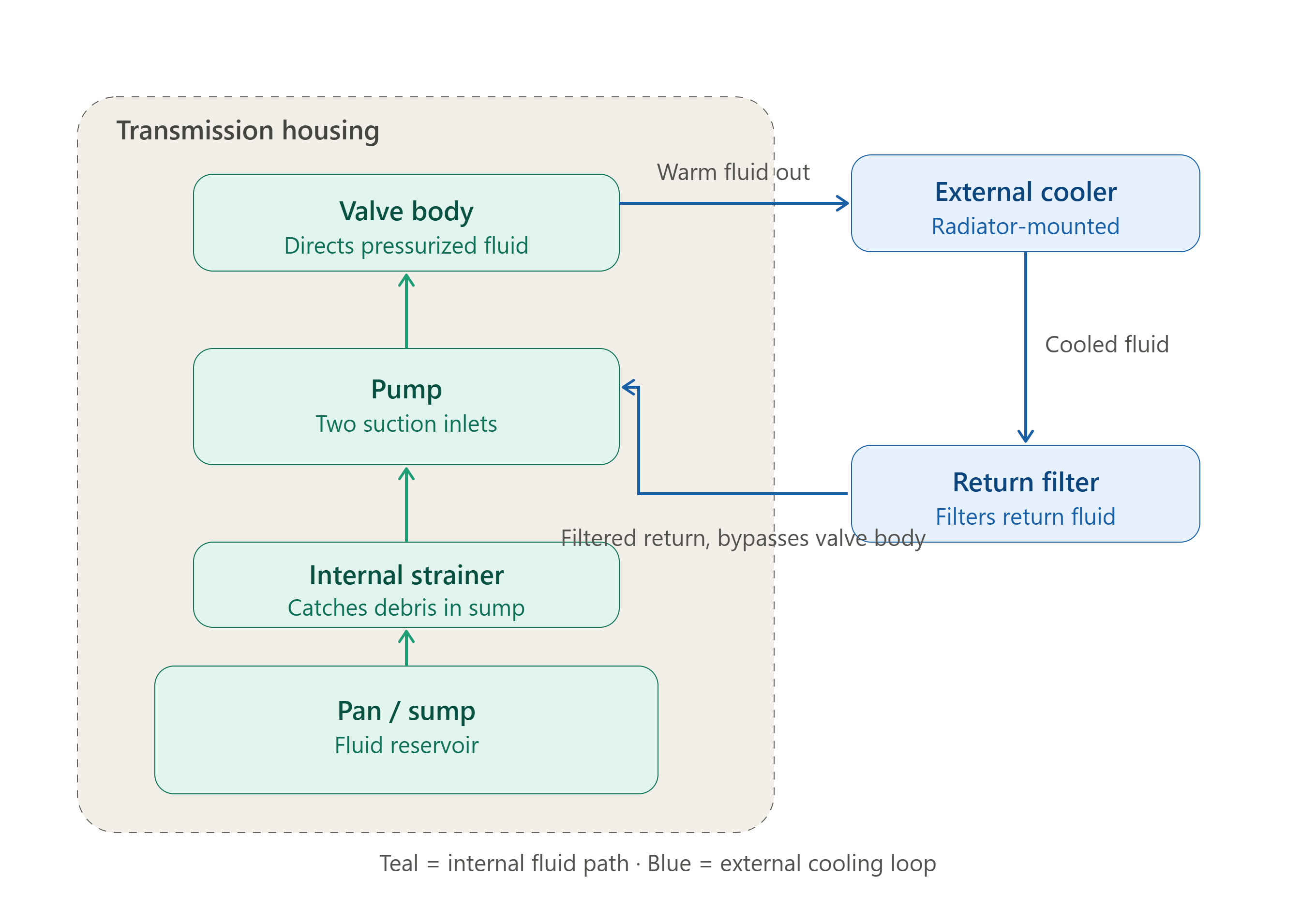
Diagram showing the internal fluid path (teal) and the external cooling loop (blue), including where the return filter sits relative to the pump, valve body, and internal strainer.
What the Cooler Return Filter Is
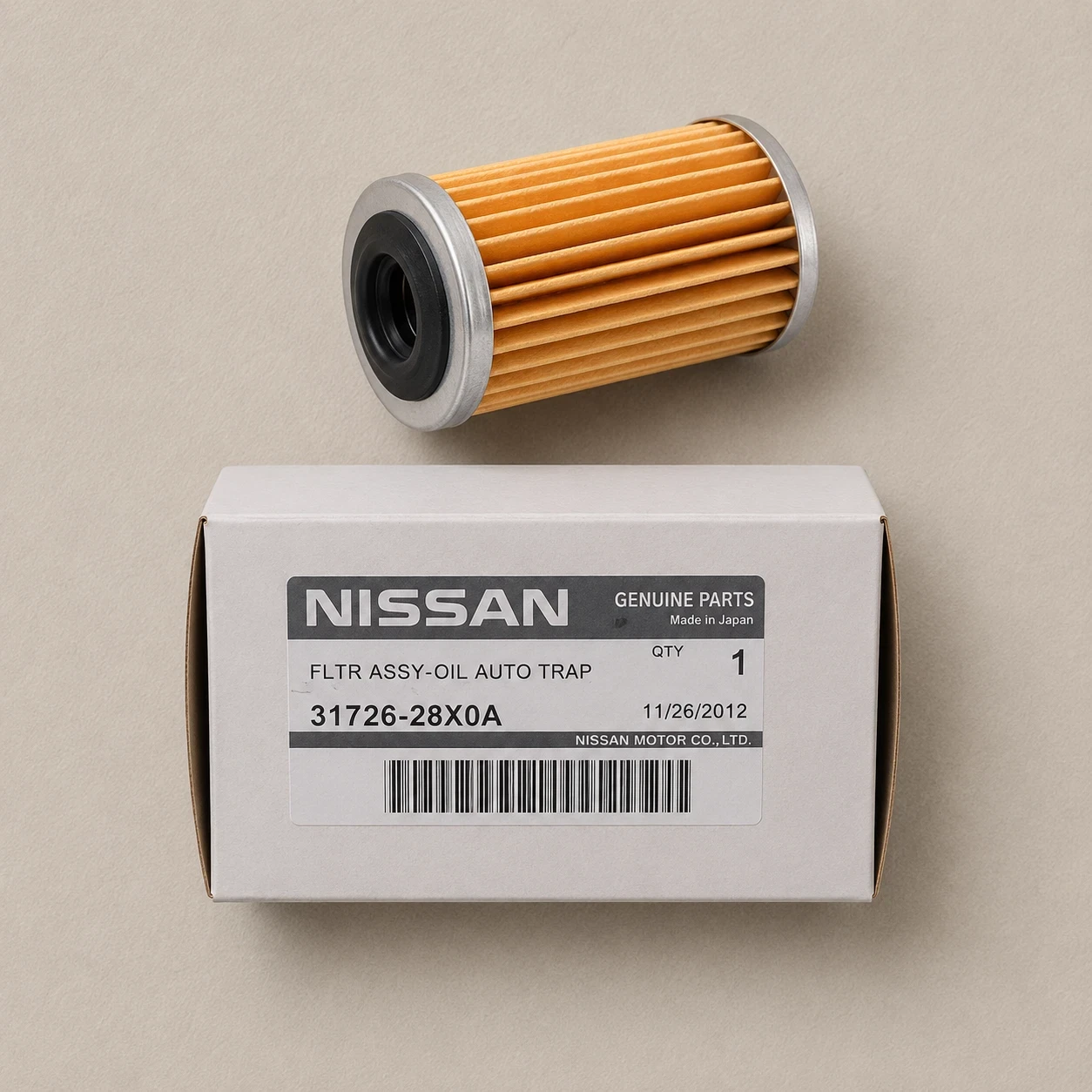
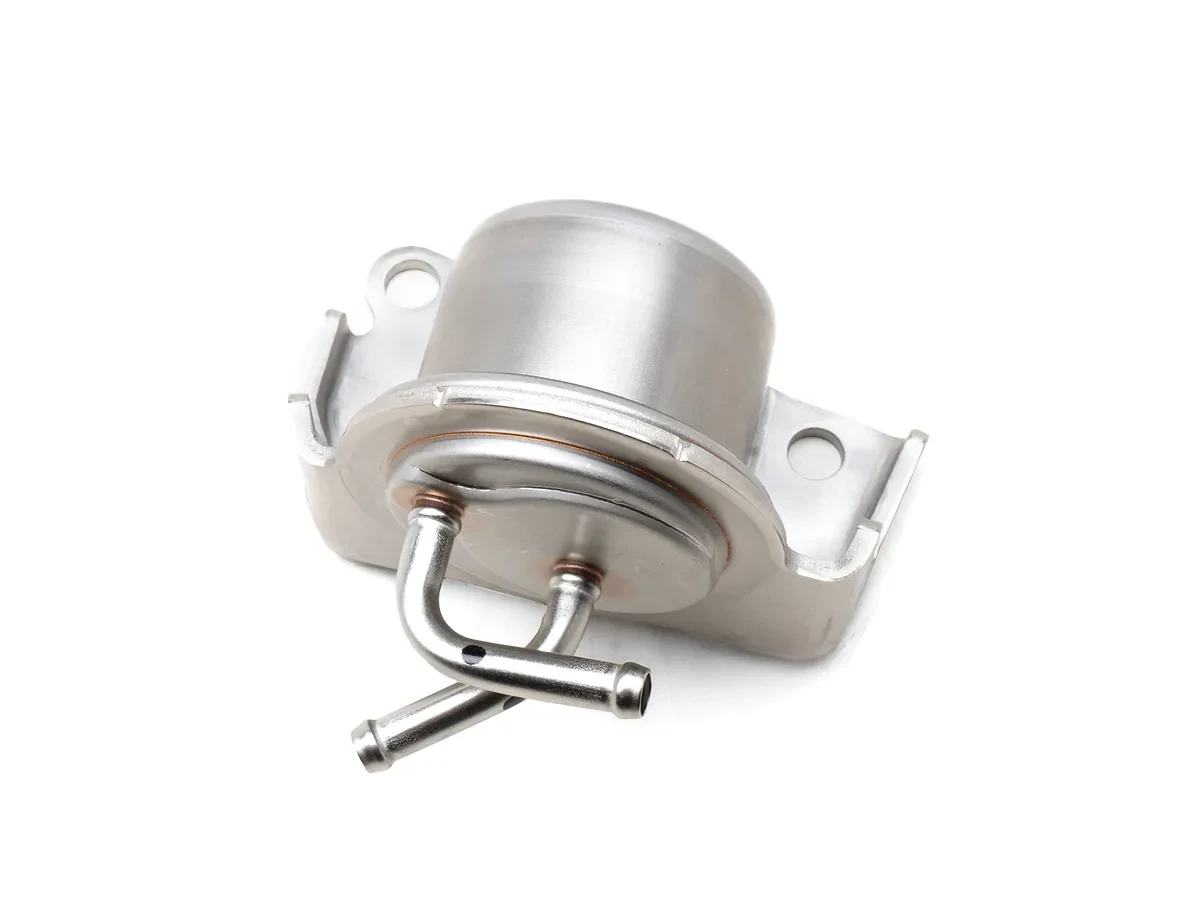
The cooler return filter is a separate, external filter mounted inline with the CVT's cooler lines — distinct from the internal pan strainer. On newer Nissan/Jatco pump designs, it feeds a dedicated second inlet port, letting cooled fluid rejoin circulation without passing back through the valve body. Because it clogs independently of the internal strainer, it's easy to overlook during a "standard" fluid service, even though it protects a completely separate part of the fluid circuit.
How Replacing It Can Resolve Many CVT Symptoms
A clogged return filter restricts how much properly cooled, filtered fluid actually makes it back into circulation, starving the transmission of conditioned fluid even when the belt, pulleys, and pump are otherwise healthy. That restriction alone can produce judder, whining, hesitation, and overheating — symptoms that often get misdiagnosed as major internal wear. Replacing this inexpensive filter alongside the internal strainer frequently resolves these complaints without any deeper repair being necessary.
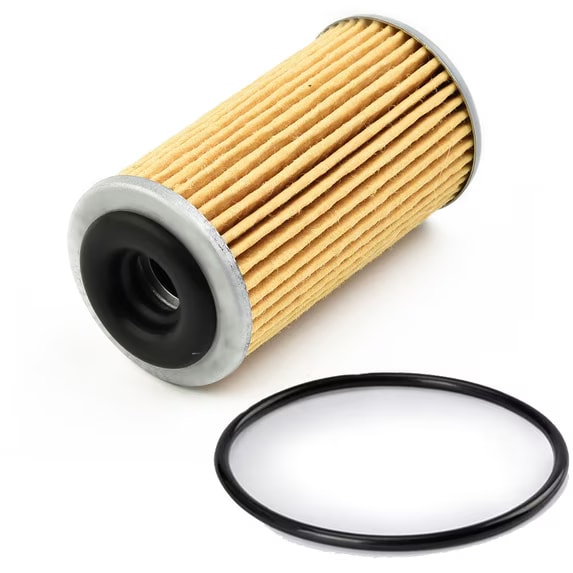
Nissan CVT Cooler Return Filter Service — San Marcos, TX
Riley Auto Care & Transmissions — Serving San Marcos, Kyle, Buda, New Braunfels & Austin, TX
Riley Auto Care & Transmissions offers cooler return filter replacement as a standalone service — replacing the external cooler return filter on its own, or paired with a full internal strainer and fluid service for a complete Nissan CVT fluid service.
Schedule This Service TodayNissan CVT Filters
A Deep Dive: The Cooler Return Filter
If there's one part of this system that's routinely misunderstood by owners — and honestly, occasionally by technicians unfamiliar with CVTs — it's the cooler return filter. This is worth its own explanation because confusing it with the transmission's main internal filter can lead to a service that looks complete on paper but actually leaves a major source of contamination untouched.
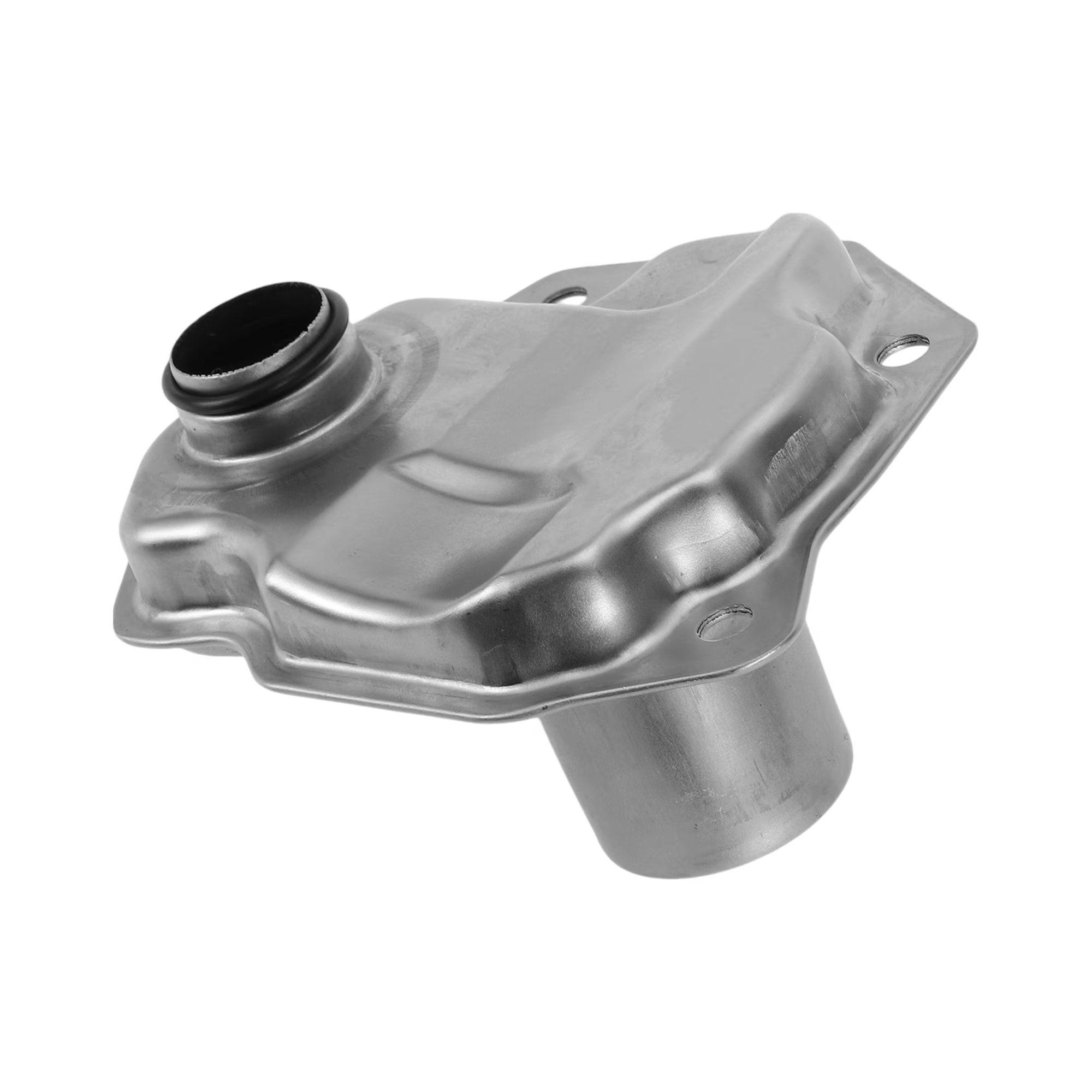
Every automatic transmission, including a CVT, has an internal filter (sometimes called a sump filter, suction filter, or strainer) sitting inside the pan, right where the pump draws fluid in. Its job is straightforward: catch debris before it's pulled into the pump on the suction side.
The cooler return filter is a completely different, separate component. Rather than living inside the pan, it's mounted externally on the transmission housing, inline with the cooler lines, specifically filtering fluid as it comes back from the external cooler before that fluid re-enters the transmission. In some Nissan CVT pump designs, this distinction is even more deliberate than it sounds: newer pump architectures use a second dedicated port fed directly from the cooler return through this external filter, specifically engineered so that returning cooler fluid doesn't have to travel back through the valve body at all before rejoining circulation. That's a meaningful design detail — it means the external filter isn't a redundant backup to the internal strainer, it's protecting a completely separate fluid pathway.
Why does this matter so much in practice? Because the internal pan strainer and the external cooler return filter clog and degrade independently of each other, on different schedules, catching different things. It's entirely possible for a shop to drop the pan, replace the internal strainer, and put in fresh fluid — a service that looks thorough — while the external cooler return filter, sitting outside the transmission and easy to overlook, remains original, clogged, and dark with old debris. Field reports from technicians replacing both filters together consistently describe the external paper filter coming out significantly more discolored and contaminated than the internal metal strainer, since it's positioned to catch the finer material that makes it through the rest of the system.
A clogged or neglected cooler return filter has real consequences. Because it directly restricts how much cooled, filtered fluid makes it back into circulation, a clogged one can starve the transmission of properly conditioned fluid, contributing directly to the same judder, whining, and hesitation symptoms associated with more serious internal wear — even when the core belt, pulleys, and pump are otherwise in good condition. In other words, this small, inexpensive, often-overlooked filter can be the actual root cause behind symptoms that look — and get diagnosed — like a much bigger, more expensive problem.
For that reason, a properly done Nissan CVT fluid service should always address both filters together: the internal pan strainer and the external cooler return filter. Servicing one without the other leaves half the filtration system in whatever condition it was already in — which, on a transmission this sensitive to fluid condition, is a real gap, not a minor detail.
The Bottom Line
Nissan's CVT technology isn't inherently defective, but it is genuinely less forgiving of neglect than a traditional automatic, and its documented history of judder, overheating, and premature wear is well established through both legal settlements and Nissan's own service bulletins. The clearest, most consistent theme across every source covering this transmission is the same one: consistent, correctly-specified fluid and filter service — both filters, not just one — is the single most effective thing an owner can do to avoid becoming part of that statistic.
If you'd like us to look into your specific Nissan's transmission code, service history, or whether any warranty coverage might still apply, we're happy to help.
Nissan CVT Solutions — San Marcos, TX
Serving San Marcos · Kyle · Buda · Seguin · New Braunfels
Family owned and operated since 1978. If your Nissan CVT is slipping, shuddering, or overdue for service, bring it in — we'll diagnose it accurately and give you an honest recommendation.
Sources & References
The technical information on this page was compiled from the following industry sources.
Gears Magazine
- "Mysteries of CVT Transmissions: A Journey Through History, Technology, and the Road Ahead"
- "The 2018-2020 Nissan Kicks RE0F11B Comparison to the RE0F11A"
- "The Mystery Behind Nissan/Jatco CVT Pulleys"
- "Tackling The Nissan CVT Jatco Transmissions: Basic Checkout"
- "Jatco CVT Pressures Diagnostics"
- "The Jatco CVT: Obstacles to the Overhaul with Insight from Robert Bateman"
- "Getting to Know Nissan's CVT-Driven All-Wheel Drive System"
Transmission Digest
- "CVT Maintenance Basics"
- "CVT Success: In-Vehicle Isolation of Common Problems"
- "CVT World"
- "Don't fear customer complaints about CVTs"
NHTSA (Nissan official bulletins)